
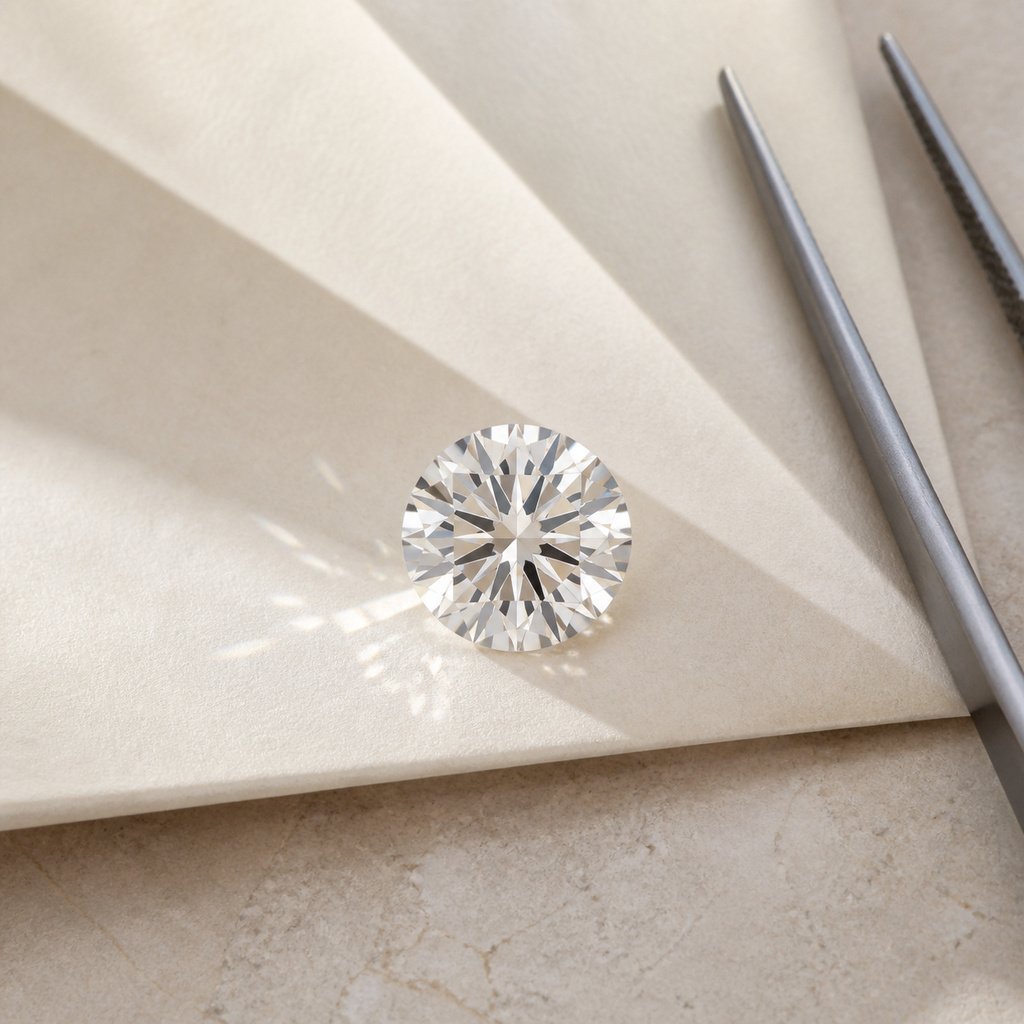
Cut is the one that does the work
Three different things get called cut, and separating them helps. Shape is the outline — round, oval, pear, emerald. Cutting style is the facet arrangement inside that outline — brilliant, step cut, and the modified versions of both. Cut quality is a third thing again: the proportions and facet arrangement that decide how light travels through the stone and comes back to your eye, described as brightness, fire and scintillation. Polish and symmetry sit alongside these as measures of finish, and are reported separately.
A well-cut stone looks alive. A poorly cut one can look flat even if everything else on paper is excellent. If you only pay attention to one of the four, make it this one.
One boundary to keep in mind: GIA gives an overall cut grade to standard round brilliants, which are the shape with standardised facets. Fancy shapes are assessed differently, so there is no single cut grade to compare across every outline.
Colour is about how little you see
Most diamonds sold as white are graded on a scale that runs from colourless downwards, with each step describing a faint warm tint.
The steps are subtle. Under normal light, and especially once a stone is set in metal, differences that look meaningful on a chart are often very hard to see. It is worth comparing grades in person before deciding how much the distinction matters to you.
Clarity covers inclusions and blemishes
Almost every natural diamond formed with small internal features, called inclusions; blemishes are their equivalent on the surface. A clarity grade is not a headcount. It reflects how many there are, how large, where they sit, how much they stand out, what type they are, and how readily they can be seen at 10× magnification.
Many of them are invisible to the unaided eye. Whether you can see anything yourself, at normal distance, is a real consideration when you are choosing — but it is a separate question from the grade, and it does not stand in for it.
Carat is weight, not size
Carat measures weight. Two stones of the same carat can look different in size depending on how they are cut and how wide they appear from above.
Prices tend to step up sharply at round numbers. Sitting slightly below a popular weight sometimes gives a stone that looks nearly identical face-up.
Cut
How well the stone returns light — the main source of sparkle.
Color
How close the diamond is to colorless; subtle steps, real differences.
Clarity
Inclusions inside the stone and blemishes on its surface — most are invisible without a loupe.
Carat
Weight, not size — and never the whole story.

How they fit together
The four are a trade-off, not a scorecard. Pushing every factor to its maximum is rarely the most sensible use of a budget, and the balance that suits one person will not suit another.
The useful question is not which grades are highest, but which combination looks right to you and makes sense for how the piece will be worn.