
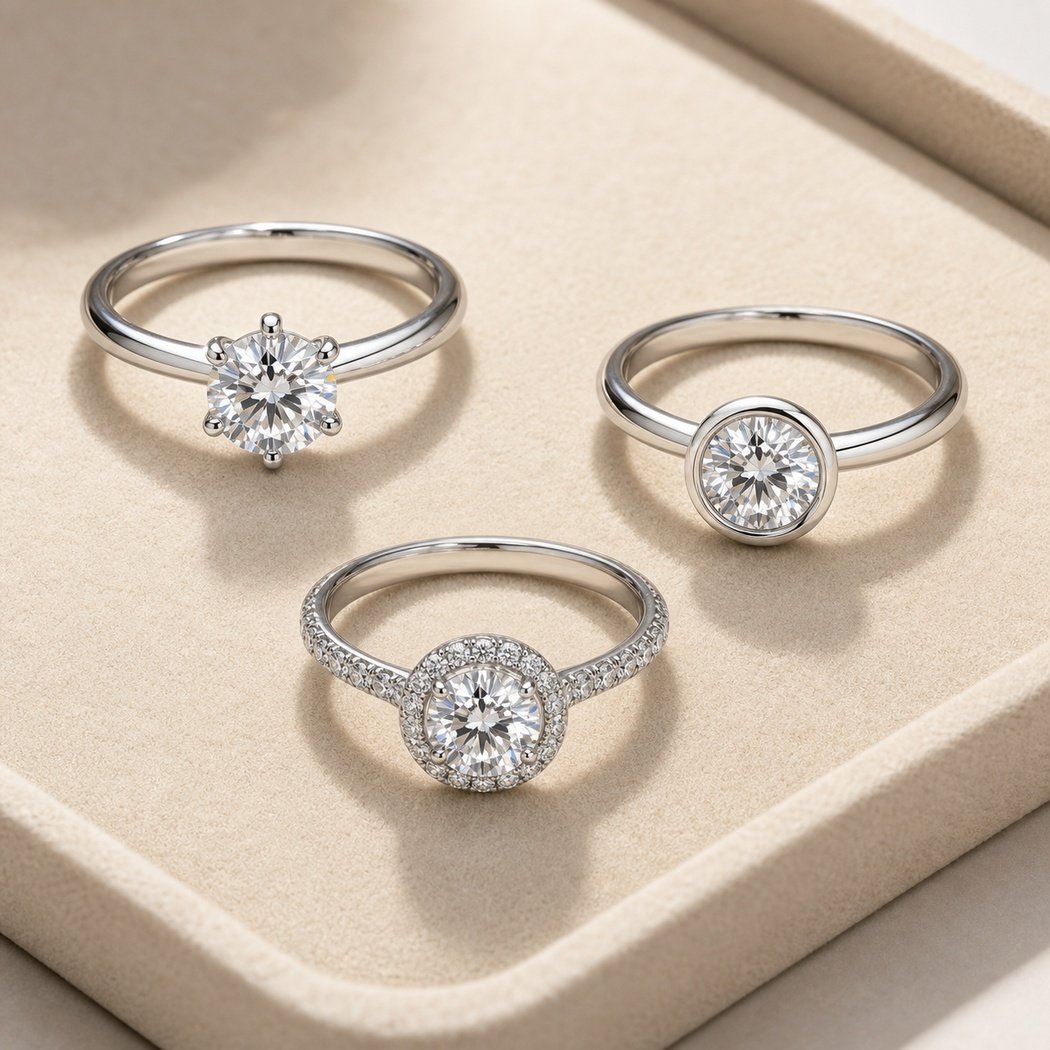
Solitaire
A solitaire holds one stone on a plain band. Nothing competes with the centre, and the design tends to age well because it does not belong to any particular moment in fashion.
Because there is nowhere to hide, a solitaire asks more of the stone itself. It is also the easiest style to clean and generally the simplest to repair or reset later.
Halo
A halo surrounds the centre stone with a ring of much smaller ones. The effect is to make the centre read larger and to add brightness around it.
It is a way to get visual presence without a larger centre stone. The trade-off is more small settings to look after over time, and a look that is more of its era than a plain solitaire.
Pavé
Pavé sets small stones along the band itself, close together, so the metal almost disappears beneath them.
It adds light along the finger rather than only at the centre. Worth asking about: how the stones are secured, and what happens if the ring later needs resizing, since a fully paved band is more complicated to alter.
Think about the hand, not the photograph
Settings photograph very differently from how they wear. A design that looks striking straight on may sit high on the finger and catch on clothing; a lower profile is often more comfortable for everyday wear.
If the ring will be worn beside a wedding band, try to see how the two sit together. Some shapes leave a gap, which may or may not bother you.
Metal and upkeep
Metal choice affects colour, weight and how the stone reads. It also affects maintenance: some finishes need periodic attention to keep looking as they did at the start.
Any specific care, resizing or aftercare arrangement depends on the company you buy from and should be confirmed with them directly.